
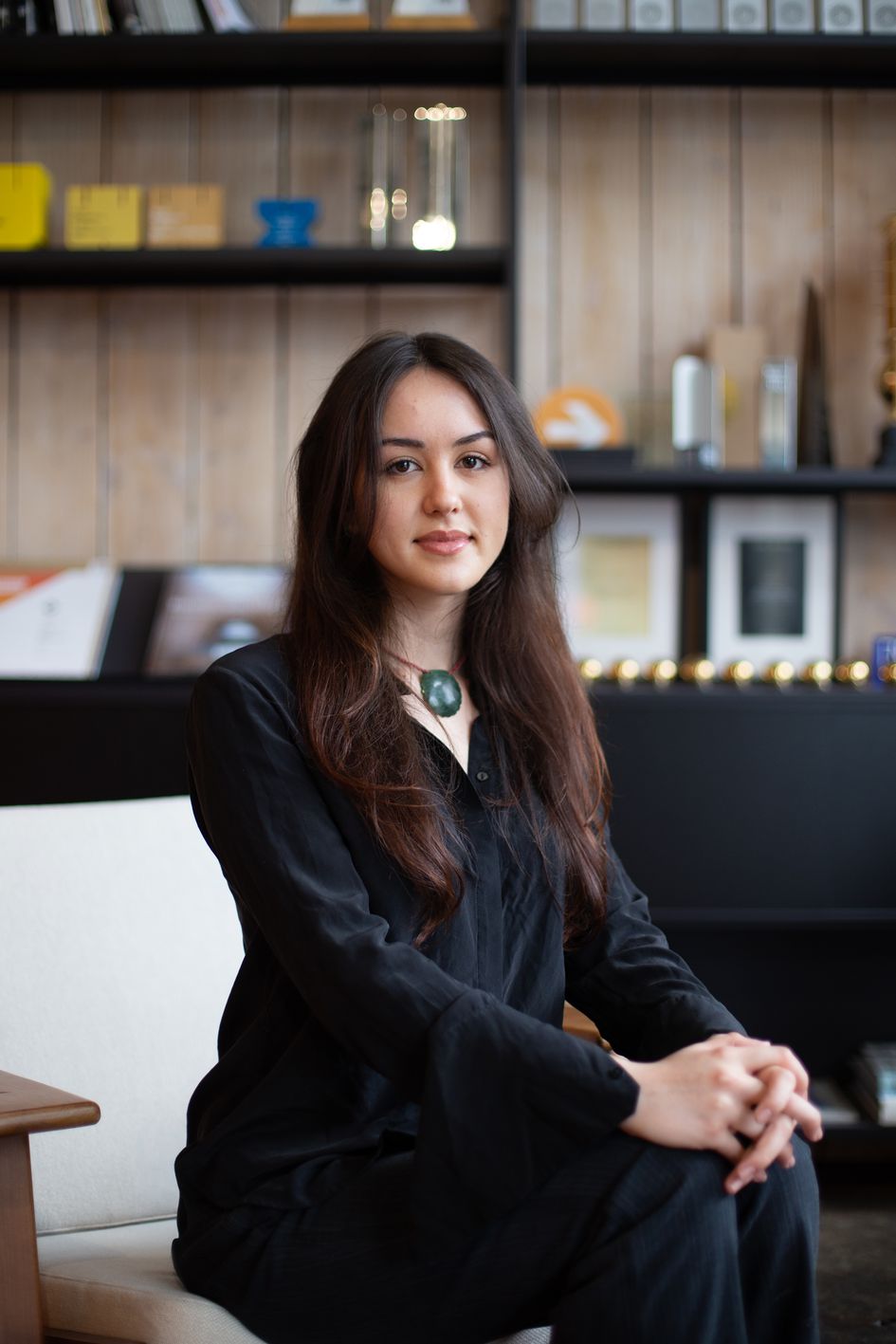
“Being at the school and seeing how te ao Māori could be expressed through built form sparked my curiosity not just for architecture, but Māori architecture,” says the 2026 recipient of the RTA Studio Scholarship for Māori Architecture Students.
Maia has a multi-cultural background. She is Ngāti Kurauia by descent on her father’s side and maintains strong ties to Puhaorangi marae in Tokaanu. Her maternal line is Lebanese, although the family is third-generation immigrants to Aotearoa.
Growing up in Titirangi, she had an interest in “putting things together”, be that sewing or making dolls’ houses. Her dad, a choreographer and artistic director of the New Zealand Dance Company, meant the household was filled with movement and music, but he also had a maker’s heart. “Dad reconstructed our entire back yard and built a gazebo – so that type of creativity must be in the genes,” says Maia.
Having just finished her final crit following her first year at the University of Auckland, Maia realises she still has a lot to learn. She’s indebted to her tutor, Mya Dixon, who not only guided her in how te ao Māori can be woven into design thinking and outcomes, but encouraged her to apply for the RTA Studio scholarship.
Being awarded this financial support gives the 19-year-old more time to zone in on the demands of her studies, rather than pursuing several part-time jobs.
In the summer holidays before the next semester begins, Maia is fortunate to be travelling with her family on an exchange trip to Japan. “I’m excited to learn more about other indigenous cultures, such as the Ainu, who we are partnering with for the exchange.” She is looking forward to discovering how different cultures have historically shaped, for example, sustainable villages, and how their values are expressed through architecture.
Back home, when she isn’t attending lectures or workshops, she likes to be creative “just for the sake of it”. She’s painting abstracts in watercolour – “combining shapes” – as gifts for friends who she hasn’t had much time to catch up with lately.
She is excited about the future for Māori applications in architecture. “The land and the whenua are not something we own, but something that is part of us. In the next couple of years of my degree, I want to learn more about how we can, with architecture, be a guardian of that. I want to practice design that encapsulates tangata whenua and our values.”