
When Hawke’s Bay Airport required a new facility to replace the sizeable kitset garage that then housed the engines, we considered mass timber first…This approach aligned with our client’s strategic plan: the airport, the third busiest in the North Island, has committed to the Airport Carbon Accreditation programme – a global initiative with a series of levels that work towards the goal of becoming carbon neutral.
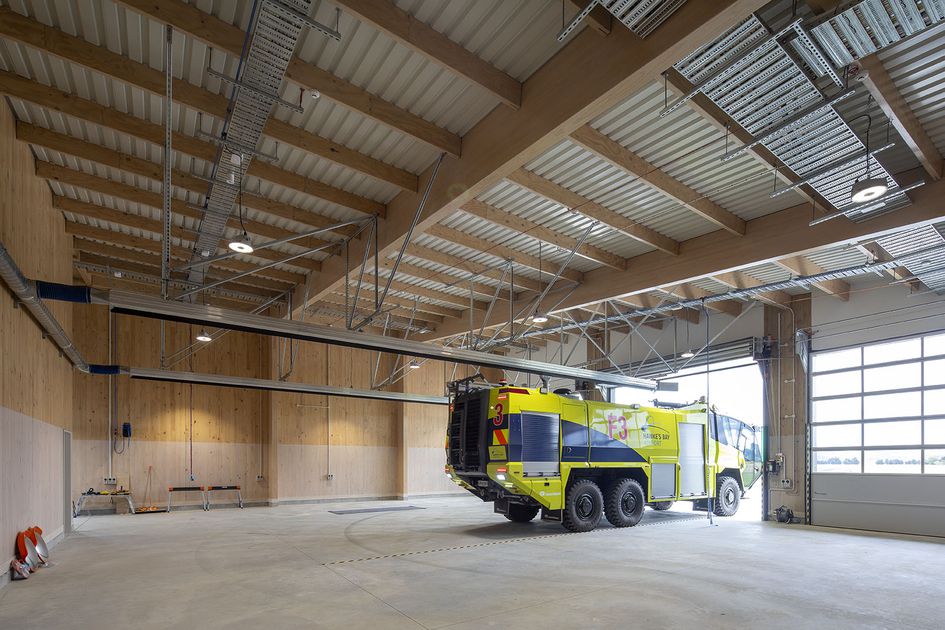
Avoiding the common steel-frame methodology, the 550sqm building employs columns and ceiling beams in glulam timber and wall panels in cross-laminated timber instead. Low-carbon concrete was used for the foundations, floor slabs and external areas. The fire-safety criteria of the timber surfaces were tested to ensure an Importance Level 4 rating, integrating the resilience required of a post-disaster response facility.
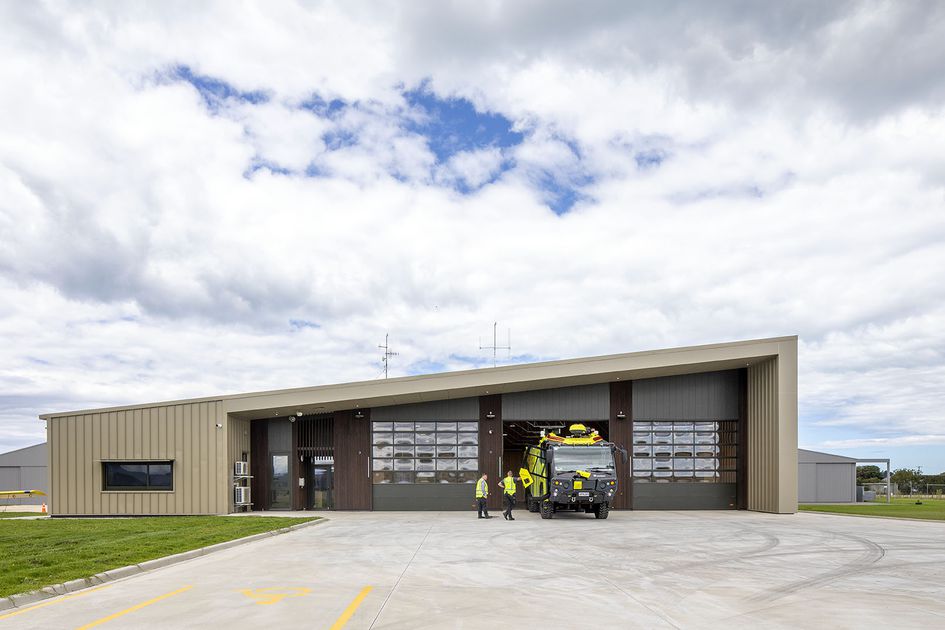
The project follows a more-with-less philosophy and involved crafting a long building with a monopitch roof that soars above a triple-bay garage which can accommodate up to three fire appliances (two existing), and dips down at the opposite end to shelter a more intimate-scale office with kitchen and open-plan workspace alongside a separate control room.
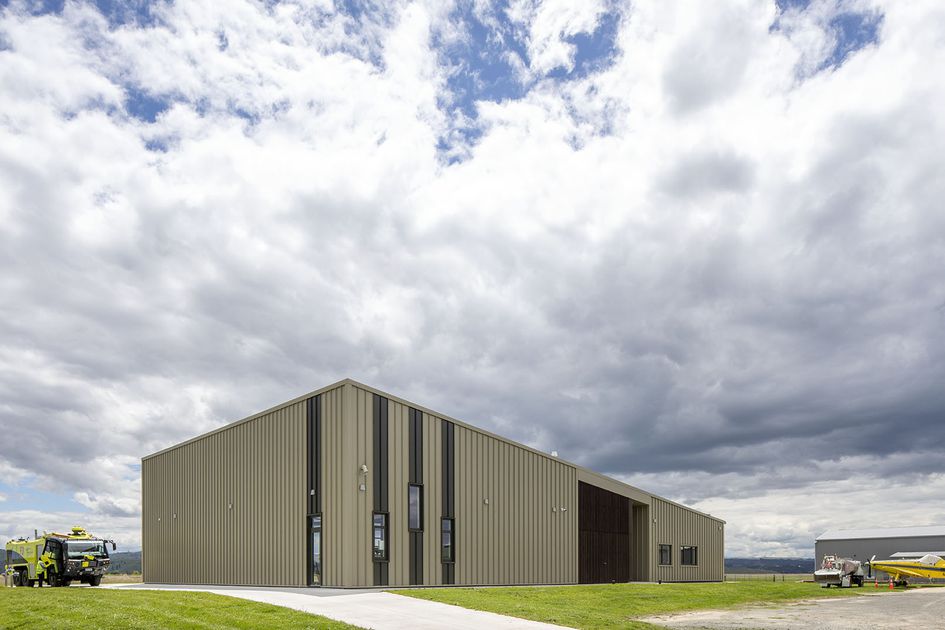
Located airside at the south-east end of the runway, it was important to lend some personality to the rectangular volume, within the confines of a challenging budget. The stripped-back form is wrapped in green-gold corrugate – a colour that alludes to the tawny farmland of the region and the nearby Poraiti hills. On the rear elevation, vertical slot windows that provide light into the workshop are picked out with bands of Colorsteel in a darker shade of green.
Internally, the lower section of the prefabricated CLT walls has been given a light whitewashed glaze to a height of 2.2 metres, the grain of the wood still visible. This lends practicality for easier clean-ups/decontamination of vehicles within the parking bay but carries through as a decorative datum line into the administrative part of the building, too.
Solar panels on the roof (oriented to avoid sunstrike for passing aircraft) generate electricity for day-to-day needs and key in with the proposal to install a substantial solar farm on the wider airport property. Rainwater is collected for fire-fighting and operational use.
Completed late 2025 and future-proofed for 50 years, the station is low-key within the landscape of this busy regional hub and will only really be noticed from the air. Next time you’re up there, look down. For an airport which has its roots in an aero club that set up on reclaimed lagoon land in 1931, things are really taking off.