
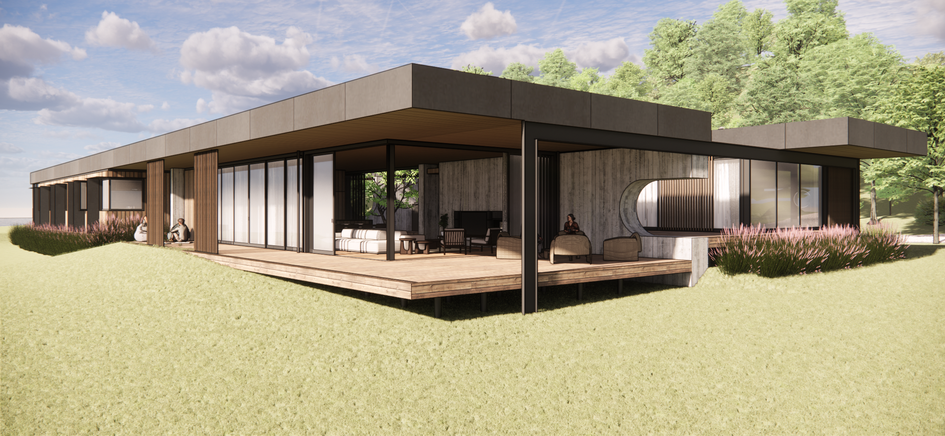
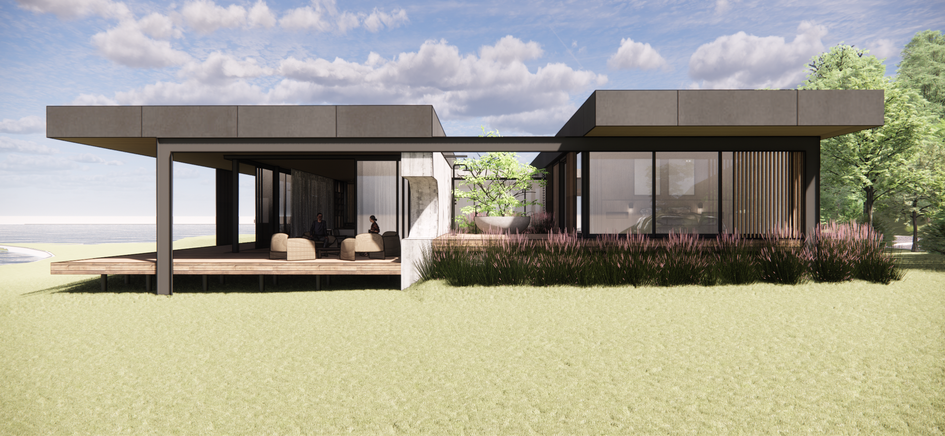
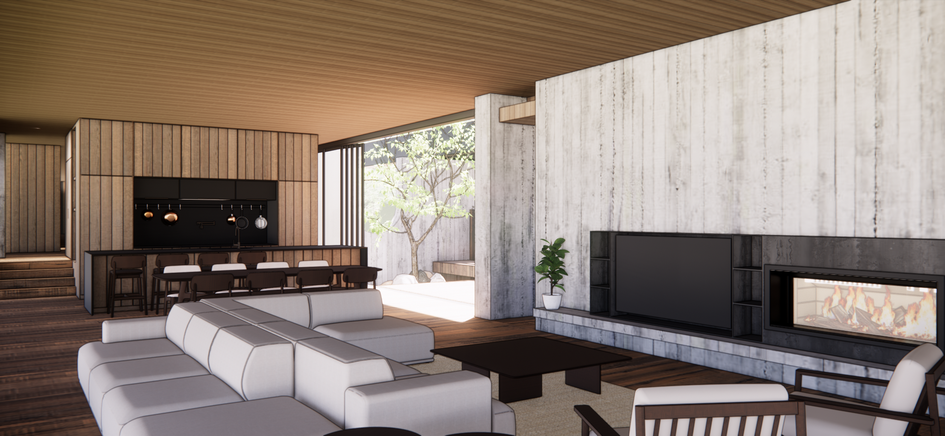
“A Japanese, pavilion-style courtyard house was the opening idea,” says the owners’ son Charlie Smail. While golf is also his métier, an interest in buildings is part of his fabric. “I did an initial design on SketchUp, using a palette of concrete, steel and timber,” he explains. Working with this original concept, RTA Studio’s Richard Naish melded international input with boots-on-the-ground contextuality.
The dwelling rests on a grassy plot in a private enclave, it’s back to a ridge, its face to the tidal mud flats. A distributed trio of offset pavilions makes up the form. Long, low rooflines with deep eaves float into the entry court where a shutter-boarded concrete connector – a seawall of sorts – shields internal spaces from view. U-shaped cut-outs in this solid intervention draw the eye, including across two internal courtyards and beyond to a large, distinctive rock that emerges from the sea. This natural feature is an axial point for the pavilions, a drawcard of orientation and place. “I love the way Rich took the brief and ideas we gave him and related it to the site so well, with views and an aspect towards the rock,” says Charlie.
Internally, timeless materials are honestly expressed, embracing the philosophy of wabi-sabi, the idea that beauty only grows with age. With vertical and horizontal surfaces wrapped in cedar and robust in-situ concrete fireplace and gallery walls, the palette is a modern take on the traditional Japanese machiya of Kyoto.
Before construction began, an iwi blessing was held to honour the land, a karakia to clear the path and protect the project: a meeting of cultures on a picturesque peninsula by the sea.