
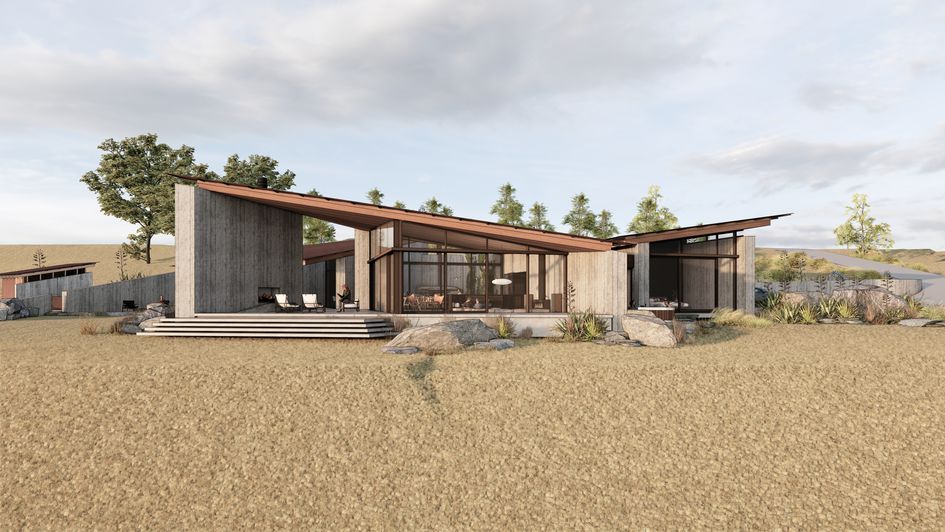
No panorama is wasted in a set-up where the primary bedroom wing is angled towards Cecil Peak, the guest quarters on the opposite branch take in the Coronet view, and the living in between is immersed in the full picture.
Having paid its respects to the backdrop, the three-bedroom dwelling turns its sights on history: gold-rush pioneers who made makeshift settlements, carved into the mountain sides. Hardy miners in the Chinese villages that sprung up from the 1860s layered up schist and stone, then topped the humble shelters with iron that oxidised to a rusty red.
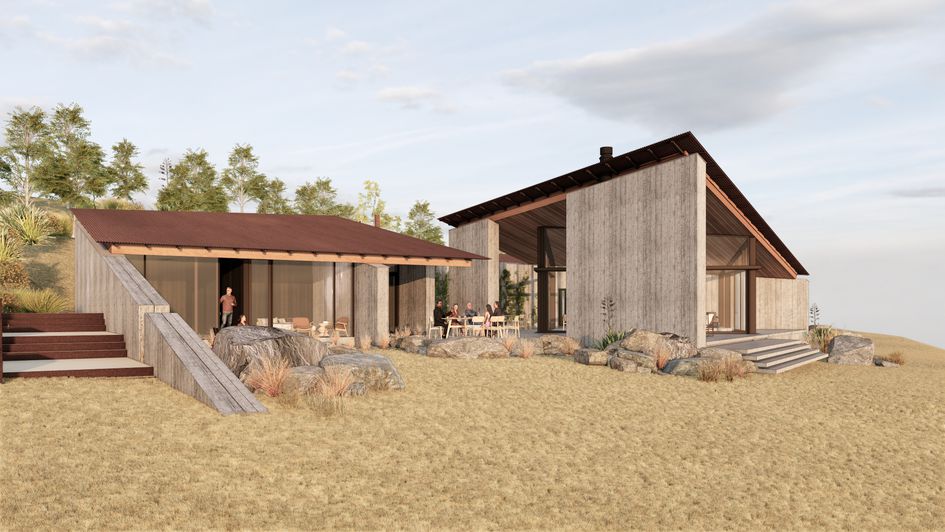
The conceptual idea of hunkering into the land is carried through here, with masonry walls that emerge from the ground to form the vertical structure. Board-finished concrete appears to emerge from the earth as perimeter walls and robust blade walls which support a trio of corrugated Corten monopitch roofs that slice this way and that.
Elegance and extremes collide in the sloping plane above the main living zone. The fine-edge roof pushes the engineering limits to soar up to six metres, sheltering an outdoor room beneath its wing.
The footprint soaks up the angular aspects of the plan with several alfresco spaces tucked into the centre of the V. An east-facing internal courtyard, which the owners have dubbed ‘the canyon’, teams the upright awesomeness of sheer concrete walls on three sides, with full-height glazing to the kitchen zone - a counter link that provides connection and comfort. Beyond the peninsula bench, a sunken seating area around a fireplace puts conversation at the heart of the plan.
For the clients who love living in the great outdoors, the reduced palette of concrete, timber and steel is a pared-back presence that has no wish to compete with the elemental. On a terrace leading from the main bedroom, a hot tub faces the drama of a peak named after the eldest son of William Rees, the founding father of Queenstown. And giant-slab boulders from the local Arrowtown quarry reinforce the conceptual message, anchoring the architecture to its present - and the past.